LATEST BLOG
- Home
- /
- Learning Center
- radiatorxperts.
Industrial Radiator Repair: How to Decide Between Repair and Replacement
So let’s talk about it before that happens.
industrial radiator repair means taking a heavy-duty cooling unit out of service, cleaning it, pressure testing it, and fixing whatever is wrong, whether that’s a few leaks, a damaged tank, or a core that’s finished. Often it costs less than a new unit and takes less time than waiting on one.
What makes an industrial radiator different
How you’ll usually know something’s wrong
The gauge is the obvious one. If it creeps up under load, don’t write it off as a hot day.
Other clues are quieter. You’re topping off coolant more often than you should. There’s crusty residue around a seam. The fins are bent flat or packed with dirt. The coolant looks like rusty water, or has an oily film on it. That last one is worth taking seriously, because oil in coolant can mean an oil cooler problem or something worse, and you want it checked before it gets expensive.
One overheating event is a warning. Several is a pattern, and patterns end up costing you a head gasket.
Why they fail in the first place
Most of it comes down to a handful of causes.
Dirt is the biggest. Dust, chaff, mud, and manure clog the fins until air can’t get through, and a radiator that can’t breathe can’t cool. That’s especially true on farm and feedlot equipment, which is why there are specialty options like feedlot cores built for that environment.
What happens when you bring one in
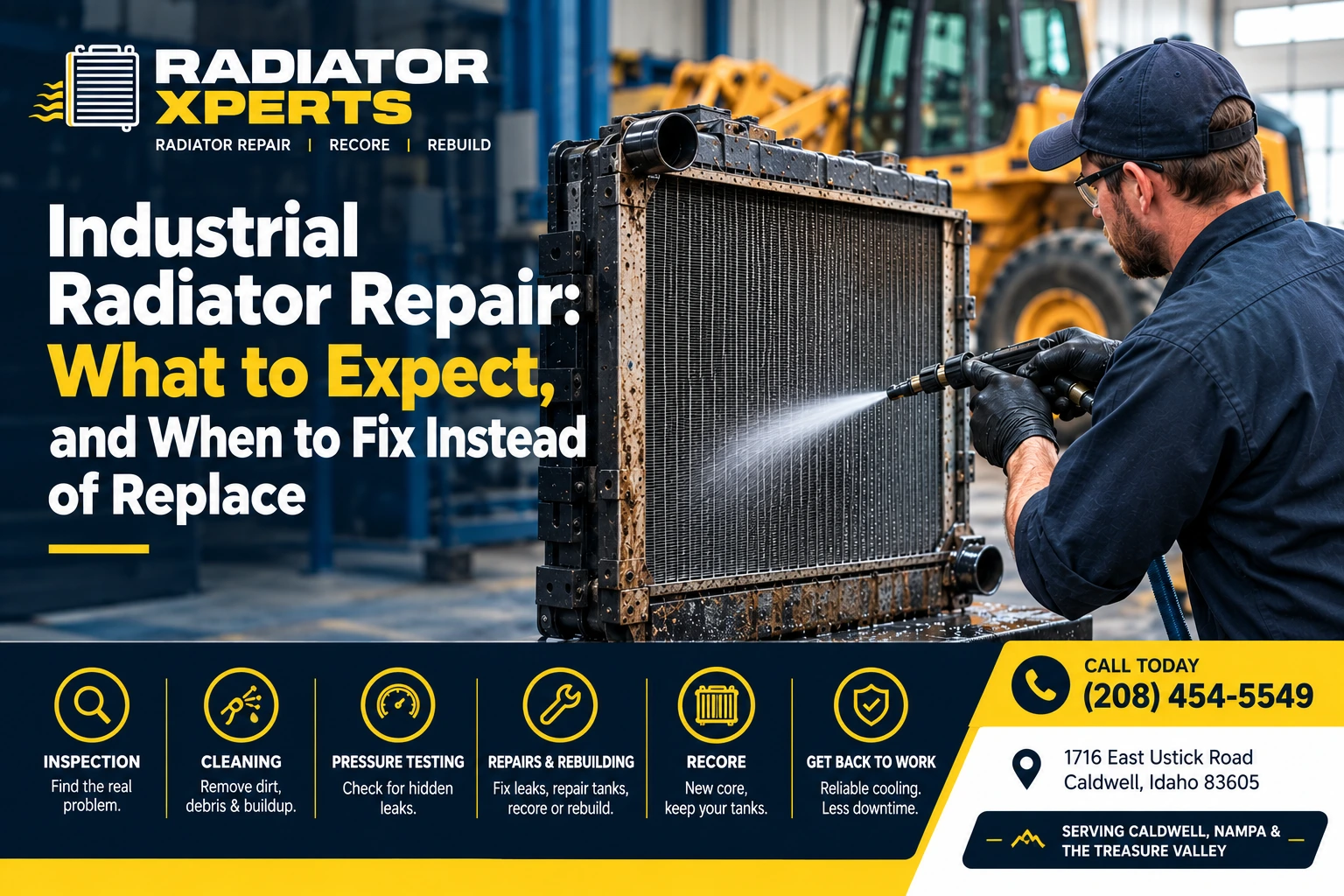
Every shop does it a bit differently, but the basics are the same. The radiator comes out and gets inspected. The core is cleaned and checked for flow. Then it’s pressure tested, because leaks that small won’t show up to the eye. Once the problem is clear, the repair happens: soldering or welding, new tanks, straightened fins, moved inlets or outlets. If the core is too far gone, it gets recored. And the unit should be tested again before it goes back on the machine, since a repair that doesn’t hold pressure isn’t a repair.
Repair, recore, rebuild, or replace?
If you’ve got a few leaks and the core and tanks are solid, repair is usually the answer. If the core is plugged or crushed but the tanks are fine, you’re looking at a recore. That keeps your original tanks and mounting and swaps in a fresh core, which is often the smart middle ground when an exact replacement is hard to find. When there’s damage in several places but the frame and fittings are sound, a full rebuild makes sense. And if the whole thing is a loss, or you need something that never existed in the catalog, a custom radiator can be built.
At Radiator Xperts, the preference is to repair or rebuild the radiator you already have before pushing a cheaper aftermarket replacement. Some jobs call for bolt-on cores or solder-on cores, depending on the unit.
Copper-brass or aluminum
Copper-brass has long been the easier material to repair and it moves heat well, but it’s heavier. Aluminum is lighter and shows up on newer machines, though repairing it takes welding experience. Not every shop is comfortable with both, so ask before you drop something off. We handle aluminum radiator repair as well.
For a plain-English look at how radiators work in general, Wikipedia’s page on engine cooling radiators covers the basics.
Don’t forget what’s around the radiator
A radiator rarely goes down alone. Hoses, caps, thermostats, and fan shrouds are cheap parts that cause expensive problems. If your machine also has an oil cooler or a charge air cooler, have those looked at while it’s apart. It saves a second trip.
Keeping it from happening again
Picking a shop
Local helps more than people expect. Sending a radiator out of state means freight, waiting, and no one to talk to when something’s off.
Industrial radiator repair in Caldwell, Idaho
Radiator Xperts is at 1716 East Ustick Road in Caldwell, and we serve Canyon County and the Treasure Valley, Nampa included. We’ve been at this since 2002, working on automotive, truck, commercial, and industrial radiators for brands like Cummins Onan, Komatsu, John Deere, Hyster, Kenworth, Peterbilt, Mack, Ford, Chevrolet, and Mercedes-Benz.
You can read more about our industrial radiator repair service, look through everything on the services page, or check the Learning Center for more cooling system tips.
Industrial Radiator Repair FAQs
What is industrial radiator repair?
How do I know if my industrial radiator needs repair?
Can my radiator be repaired, or does it need to be replaced?
If the damage is mostly leaks, tanks, or fittings and the core is in decent shape, repair is usually possible. If the core is plugged or crushed, recoring may be the better route. Replacement is for units that are damaged all over. A pressure test is what settles it.
What’s the difference between repairing, recoring, and rebuilding a radiator?
Repair fixes specific damage on the radiator you already have. Recoring replaces the core but keeps your original tanks and mounting. A rebuild covers more ground, usually when there’s damage in several places but the frame and fittings are still sound.
Is it cheaper to repair an industrial radiator than to replace it?
How long does industrial radiator repair take?
It depends on the damage and what parts are needed. Simple leak repairs can be quick, while recoring and custom work take longer. Ask the shop for a realistic timeline before you drop the unit off so you can plan around downtime.
Can aluminum industrial radiators be repaired?
Does Radiator Xperts repair industrial radiators in Caldwell, Idaho?
Yes. Radiator Xperts is located at 1716 East Ustick Road in Caldwell and serves Canyon County and the Treasure Valley, including Nampa. You can call (208) 454-5549 to talk through your equipment.